Research & citations

The published record behind every number we quote.

Asymmetry Computing publishes the evidence for PRISM in three places: a peer-reviewable paper on arXiv, public evaluation artifacts on GitHub, and the benchmark pages on this site. This page is the index to all of it, with permanent links. If you want to check a claim we make, start here.

01 · Peer-reviewable research

The paper.

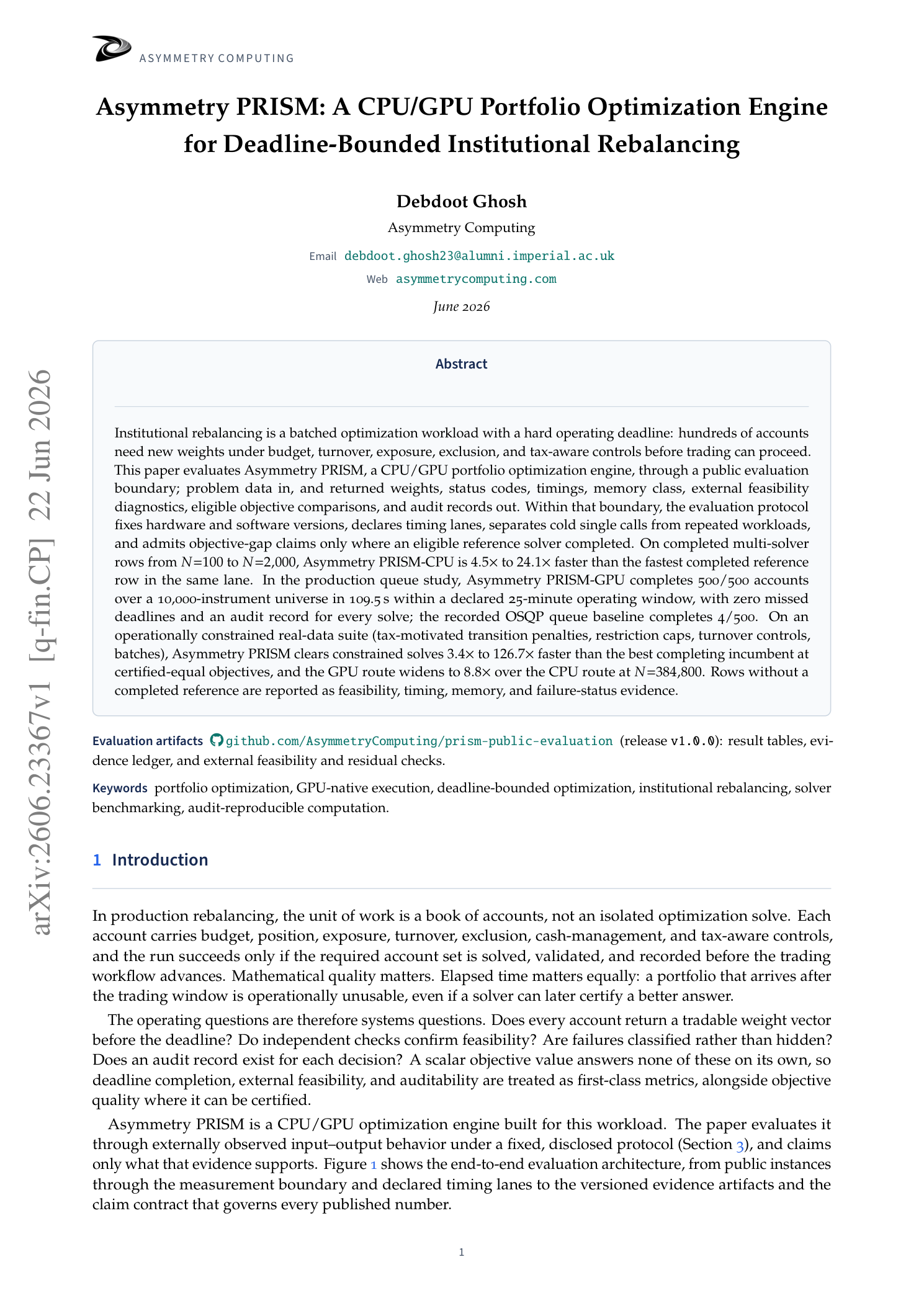
Asymmetry PRISM: A CPU/GPU Portfolio Optimization Engine for Deadline-Bounded Institutional Rebalancing. Debdoot Ghosh, Asymmetry Computing. June 2026. arXiv:2606.23367.

The paper treats institutional rebalancing as what it actually is operationally: a batched optimization workload with a hard operating deadline, where hundreds of accounts need new weights under budget, turnover, exposure, exclusion, and tax-aware controls before trading can proceed. PRISM is evaluated across a public evaluation boundary — problem data in; returned weights, status codes, timings, memory class, external feasibility diagnostics, eligible objective comparisons, and audit records out.

Three results are reported, in the paper's own terms:

  • On completed multi-solver rows from N=100 to N=2,000, Asymmetry PRISM-CPU is 4.5× to 24.1× faster than the fastest completed reference row in the same lane.
  • In the production queue study, Asymmetry PRISM-GPU completes 500/500 accounts over a 10,000-instrument universe in 109.5 s within a declared 25-minute operating window, with zero missed deadlines and an audit record for every solve. The recorded open-source solver queue baseline completes 4/500.
  • On an operationally constrained real-data suite (tax-motivated transition penalties, restriction caps, turnover controls, batches), Asymmetry PRISM clears constrained solves 3.4× to 126.7× faster than the best completing incumbent at certified-equal objectives, with the GPU route widening to 8.8× over the CPU route at N=384,800.

Rows without a completed reference are reported as feasibility, timing, memory, and failure-status evidence rather than being dropped or scored as an infinite speedup.

Abstract · PDF · Full text (HTML)

02 · Public code

The evaluation artifacts.

Result tables, evidence ledger, and external feasibility and residual checks — published so a buyer can audit the claims without us in the room.

prism-public-evaluation

Public evaluation artifacts for the Asymmetry PRISM benchmark: result tables, the evidence ledger, and external feasibility and residual checks that reproduce the figures reported in arXiv:2606.23367.

prism-di-public-evaluation

The direct-indexing evaluation repository: batched, tax-aware account solves with per-percentile latency reporting, published as a runnable evaluation harness.

github.com/AsymmetryComputing

The organization index — every public repository Asymmetry Computing maintains, including the interactive demo notebooks linked from the applications pages.

03 · Claim provenance

Every headline number, and where it comes from.

Comparators are described generically. Every figure traces to a recorded run on real data, and the losing cases stay in. See the full evidence →

ClaimWhat it measuresWhere to verify
~5 ms CAISO dispatch A feasible, audited grid dispatch plan returned within deadlines from 500 ms down to ~5 ms, on real California ISO data. Energy dispatch
75,257-asset rebalance in under a second A full rebalance with factor and specific risk attribution plus an audit trail, at a universe size where standard optimizers stall. Portfolio decisioning
$238K tax budget captured The full harvestable tax budget captured on a $5M direct-indexing book, measured on real US-equity data. Direct indexing
100,004 real assets backtested Backtested at approximately 1.8 s per rebalance, Sharpe 0.737. Benchmarks
4.5×–24.1× faster Versus the fastest completed reference row in the same lane, on completed multi-solver rows from N=100 to N=2,000. arXiv:2606.23367
500/500 accounts in 109.5 s Production queue study over a 10,000-instrument universe inside a declared 25-minute operating window, zero missed deadlines, audit record for every solve. Recorded open-source solver queue baseline: 4/500. arXiv:2606.23367
3.4×–126.7× faster Constrained solves on an operationally constrained real-data suite, at certified-equal objectives, versus the best completing incumbent. arXiv:2606.23367
10.2× fleet throughput Accounts priced per core against a commercial CPU baseline — the margin lever in fleet-scale direct indexing. Benchmarks

A note on method: we publish outcomes and benchmarks, not the internals of the engine. That is a deliberate commercial choice, and it is why the evaluation boundary in the paper is defined the way it is — you get the inputs, the outputs, the timings, and the feasibility diagnostics needed to check the result, and you can run the harness on your own data.

04 · How to cite

Citation formats.

Plain text. Ghosh, Debdoot. Asymmetry PRISM: A CPU/GPU Portfolio Optimization Engine for Deadline-Bounded Institutional Rebalancing. arXiv:2606.23367, June 2026.

BibTeX.

@article{ghosh2026asymmetryprism,
  title  = {Asymmetry PRISM: A CPU/GPU Portfolio Optimization Engine
            for Deadline-Bounded Institutional Rebalancing},
  author = {Ghosh, Debdoot},
  journal = {arXiv preprint arXiv:2606.23367},
  year   = {2026},
  url    = {https://arxiv.org/abs/2606.23367},
  note   = {Asymmetry Computing, https://asymmetrycomputing.com}
}

For the company itself: Asymmetry Computing, https://asymmetrycomputing.com. Founded 2025 by Debdoot Ghosh. Building PRISM, a real-time optimization engine for institutional finance.

05 · Elsewhere

Official channels.

These are the only accounts and repositories operated by Asymmetry Computing. "PRISM" is a heavily reused product name across the industry — if a result is attributed to PRISM and does not trace back to one of these, it is not ours.

Check the claims on your own data.

The evaluation harness is public. The paper is public. The fastest way to settle whether this works for your book is a pilot with a pass/fail metric you set before we start.

Request a pilot →